ITAPS
Petascale Technologies
Research | Scaling Results | PHASTA Scaling | FMDB iMesh Implementation | Mesh Adapt | Zoltan Partitioning | Mesquite Mesh Quality | FronTier parallel scaling |
Mesh Adapt Service Scaling Results
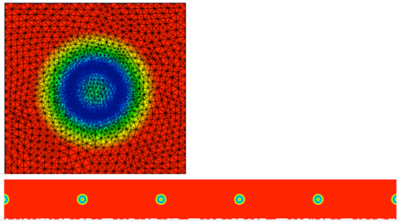
We were able to achieve nearly 70% efficiency on up to 32K processors of BG/P.
Mesh adaptation is typically characterized by small, but variable, work per operation. Therefore achieving ‘perfect scaling’ can be too costly in terms of the communication costs required to migrate elements. However, mesh adaptation is typically a small percent of the total solution time in an implicit simulation iteration and therefore perfect scalability is not required. We have been able to demonstrate that the ITAPS mesh adapt service can be run on very large numbers of processors and used effectively in the overall simulation and analysis.
In particular, we considered a weak scaling study of uniform refinement of air bubbles in a pipe. In each case the approximate work per processor as the number of processors increased remained constant by increasing both the initial and final mesh sizes. We were able to achieve nearly 70% efficiency on up to 32K processors of BG/P (see the figure and table).
# of parts |
Initial Mesh |
Adapted Mesh |
Time (s) |
Scaling Factor |
2048 |
17M |
128M |
5.0 |
1.0 |
4096 |
34M |
274M |
4.8 |
1.05 |
8192 |
65M |
520M |
5.1 |
0.97 |
16384 |
520M |
1.1B |
6.1 |
0.82 |
32768 |
274M |
2.2B |
7.4 |
0.68 |